Mother Myth Mural
Location
Installation Date: 2014
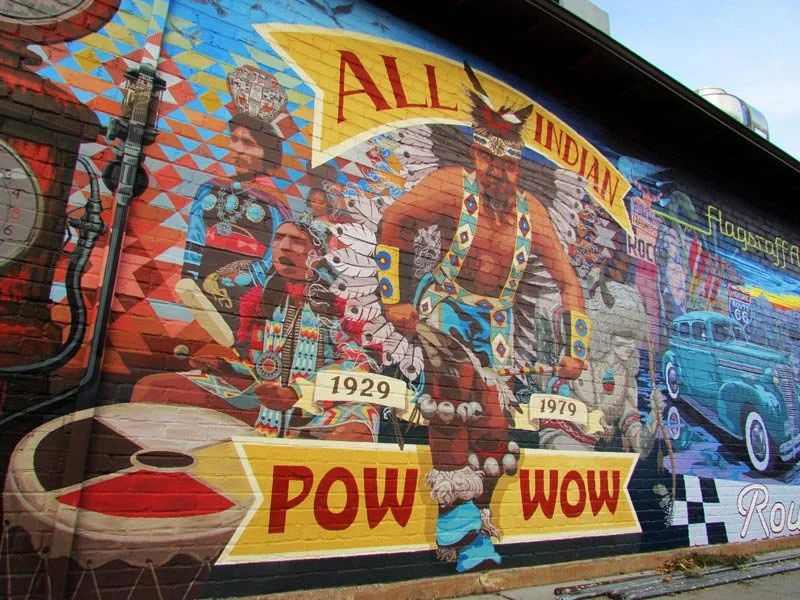
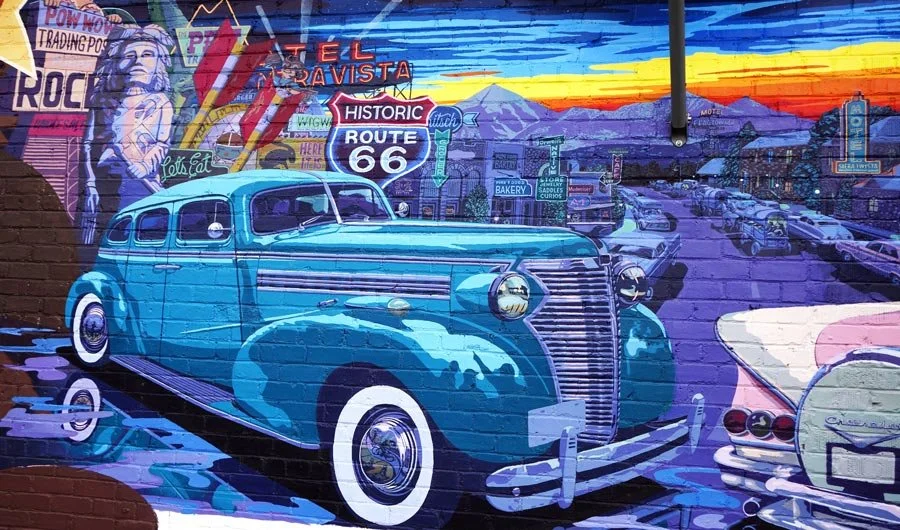
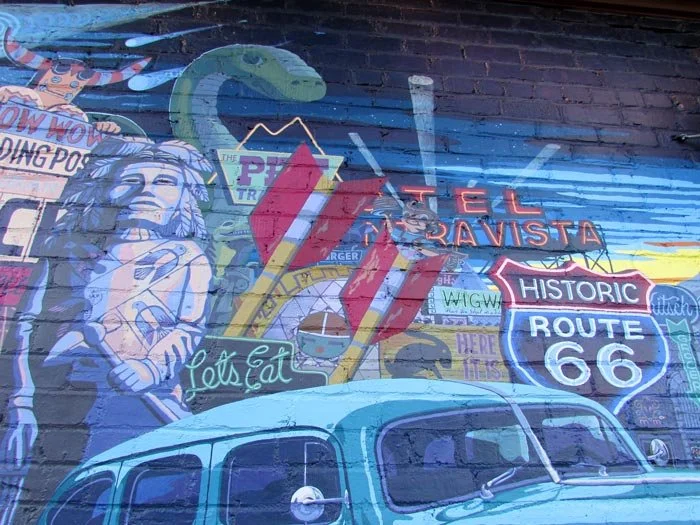
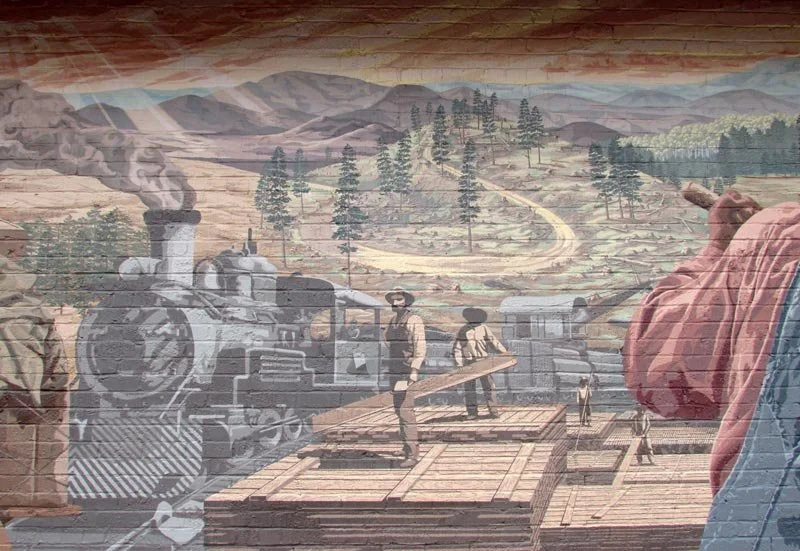
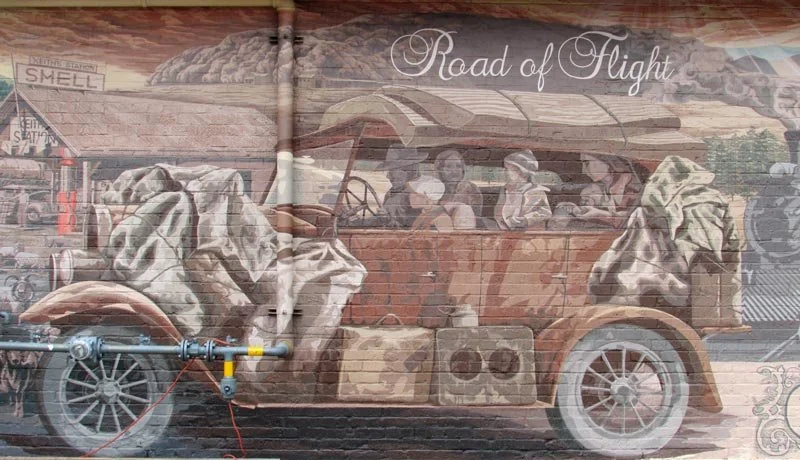
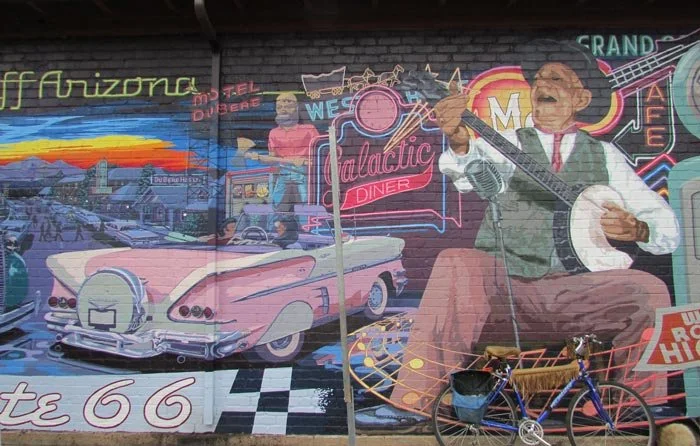
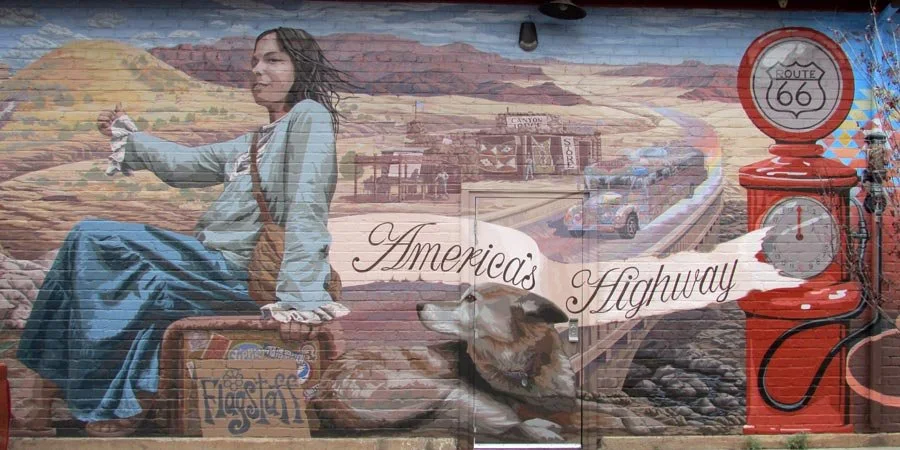
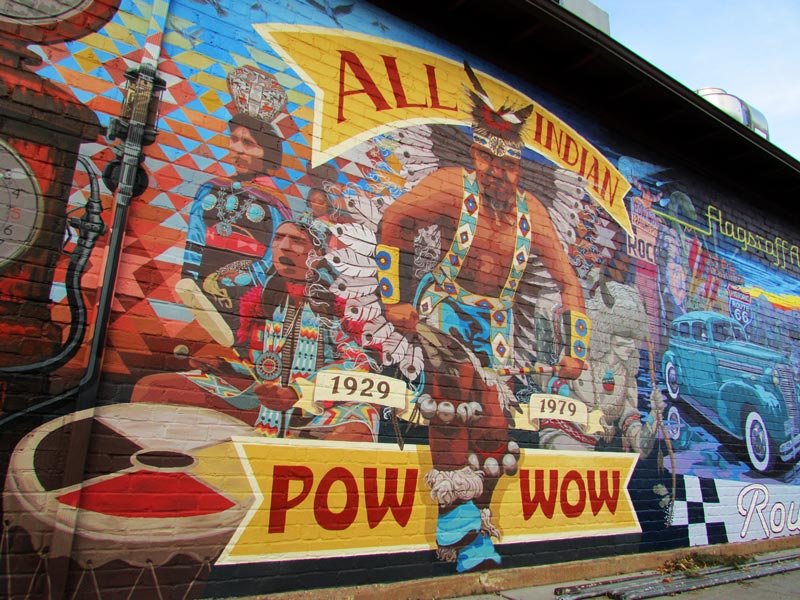
This mural, located along the original site of Route 66, illustrates the history of of the road in Flagstaff through the decades of the 1920s through the 1980s. The story begins on the right with the construction of the road and continues left through the era of the Great Depression, WWII and the post-war heyday of America’s heyday. The mural ends on the far left with the decommissioning of the highway.
Where the “Road Ends,” the romantic legend begins, keeping Route 66 alive into the 21st century is an expression of what Americans have held Route 66 to symbolize—a microcosm of American culture reflected along one great road stretching from Chicago to L.A. The artwork functions as a chronological storyboard from right to left, offering the spirit of each of the ages in 10-year increments from 1926-1985. The story begins when the road was designated as an official federal highway and given the numerical designation 66 in 1926.
About the Artwork
About the Artist: Margaret Dewar
Born and raised in Potsdam New York, Margaret moved to Eugene Oregon in 2021. She is co-founder of Mural Mice Universal and director of the Mural Mice Theater Company. She is an actor, director, and has co-produced and painted dozens of murals in the Southwest. Maggie rides unicycles, climbs mountains, doodles, and loves soccer. She is a freelance artist and clown in her spare time.
Margaret Dewar writes: Every mural is an attempt to change the world. They are a visual trsansformation of space into an expression of who we are and what we care about. The artform has played an important role around the globe and throughout history as a force for social change.
Flagstaff is a place where murals play a mjor role in the cultural expression of the community. Every mural serves a purpose, it may be for beautification or to create a landmsrk. But usually the subject is revealing of a message or statement.
Murals are folk art, they are expressions by the people for the people. The murals of Flgstaff are riddled with narratives and of identity that becomes part of our daily life. Many of these colorful walls represent a moment when people came together. The process is as criticsl as the product. All the murals we see in Flagstaff exist because people who cared came together.
In a way, every mural is a small revolutionary act unleashing the power of the artists as an active and influential force on the culture of the community. It is possible that murals are a step toward building a better world.
About the Artist: Mural Mice Universal
Mural Micer are a growing collective of artists doing both public and private art. Mice are versatile in many mediums including paint, airbrush, mosaic, and three dimensional art. They are community muralists. Their passion is to create meaningful public art for the sake of community. Their murals serve to beautify public space, provide educational resources, and engage people in an enjoyable and even therapeutic creative process.
They strive to cultivate a sense of identity and place through art. Each mural begins with the intention to transform a blank wall. Some murals depict history, some are fun and fantastical, others visionary. Anyone can become a Mural Mouse, just pick up a brush and join in the fun.
About the Artist: R.E. Wall
Born in Rochester New York on July 5th, 1970, R.E. Wall was raised in Georgia, Chicago, and Arizona. He founded Mural Mice Universal in 2005 and has since placed dozens of murals across the Southwest. In 2018, the Mural Mice won a Viola Award for Excellence in Visual Arts. He moved to Eugene Oregon in 2021. He is prolific in mixed medias, which include calligraphy, pen and ink, acrylic, oil painting, and airbrush. He is inspired by community expression through the arts.
Questions for Elementary School Families
What part of this mural caught your eye first?
What colors or shapes stand out to you?
Which part of the mural looks the oldest? Which part looks the newest? How does the artist help you to see the change in time?
Have you ever heard of Route 66 before? Why do you think it was and is important?
Why do you think people were excited to travel on Route 66?
What do you think it felt like to drive across the country in the 30s, 50s, or 80s compared to now?
Why do you think Route 66 was important specifically to people in Flagstaff?
Questions for Secondary School Families
What is the first thing you notice about this mural?
How does the mural tell a story using pictures instead of words?
What emotions or moods do you notice in different parts of the mural?
What art elements are being used to show the passage of time in the mural?
What are some events from U.S. history that are shown in the mural?
How did Route 66 change the lives of people in Flagstaff? What about people in other parts of the country?
If you could add one more part to the mural showing Route 66 today, what would it look like?
Extension Activity
To extend, create an artistic timeline of your own life. Include significant events in your life that have helped to shape you. Play around with different colors and textures to show that time is passing rather than just labeling it.